Our services
The Erosion of Sovereignty: Why the Abduction of Maduro is a Global Crisis

The geopolitical landscape was rocked on January 3, 2026, by “Operation Absolute Resolve”—a massive U.S. military strike in Caracas that resulted in the abduction of Venezuelan President Nicolás Maduro and his wife, Cilia Flores. While the U.S. justifies the mission as a necessary “judicial extraction” to face narco-terrorism charges, the world is asking a much more dangerous question: Does national sovereignty still exist, or are we returning to a “law of the jungle” where the strongest simply take what they want?
By framing an internal political crisis as a criminal matter for U.S. courts to solve, Washington hasn’t just targeted one man; it has targeted the very foundation of the international order.
A Dangerous Precedent: Venezuela’s Internal Matter
For years, the political situation in Venezuela has been undeniably fraught. Disputed elections and economic collapse are serious issues, but they are fundamentally internal matters. International law, anchored by the UN Charter, is built on the principle that the people of a sovereign nation have the right to determine their own government.
When the U.S. unilaterally decides that a foreign leader is “illegitimate” and uses special forces to “extract” them, it sets a precedent that should terrify every nation.
- The Slippery Slope: If the U.S. can abduct a leader it dislikes, what prevents China from claiming similar authority over Taiwan’s leadership? What stops Russia from using the same “narco-terrorism” or “security threat” logic to abduct leaders in its “near abroad”?
- The Death of Diplomacy: This action signals that the U.S. is no longer interested in diplomatic “off-ramps” or regional mediation. It replaces the bargaining table with Delta Force.
Negative Impact on the United States
While the administration celebrates this as a display of “American might,” the long-term blowback for the U.S. is likely to be severe:
- Diplomatic Isolation: Even close allies like the UK and Western European nations have expressed “outrage” and “alarm.” This move shatters the “values-based” coalition the U.S. has spent decades building, making it look less like a leader of the free world and more like an unpredictable hegemon.
- National Security Risks: Targeting a head of state puts every American diplomat and soldier abroad at risk of retaliatory kidnapping or “tit-for-tat” judicial actions.
- The “Endless War” Trap: President Trump’s statement that the U.S. will now “run” Venezuela suggests a long-term occupation. History in Iraq and Afghanistan shows that “running” a country is far harder than toppling its leader, and American taxpayers will once again be footing the bill for a regime-change experiment.
Impact on Global Stability
The world is now a much more dangerous place. The “dangerous precedent” cited by UN Secretary-General António Guterres is already causing a ripple effect:
- Collapse of International Law: The use of the “Ker-Frisbie doctrine”—which allows U.S. courts to try defendants regardless of how they were brought to the country—effectively tells the world that the U.S. views international law as an “inconvenience” rather than a rule.
- Regional Destabilization: South American leaders have called the attack a “grave affront” to the entire continent’s sovereignty. This will likely push regional powers further away from Washington and toward rivals like China and Russia for security.
- The Oil Factor: By openly stating the intent to “tap” Venezuela’s oil reserves, the U.S. has validated the “imperialism” narrative. This turns a supposed legal action into a resource grab, fueling anti-American sentiment across the Global South.
The Verdict
The abduction of Nicolás Maduro may be a tactical success for U.S. special operations, but it is a strategic disaster for global peace. By intervening in an internal matter with such overwhelming force, the U.S. has signaled that might makes right. In doing so, it has not brought “justice” to Venezuela—it has brought chaos to the international system.
U.S. Consumer Confidence Drops in December: What It Reveals About the Economy and What Lies Ahead
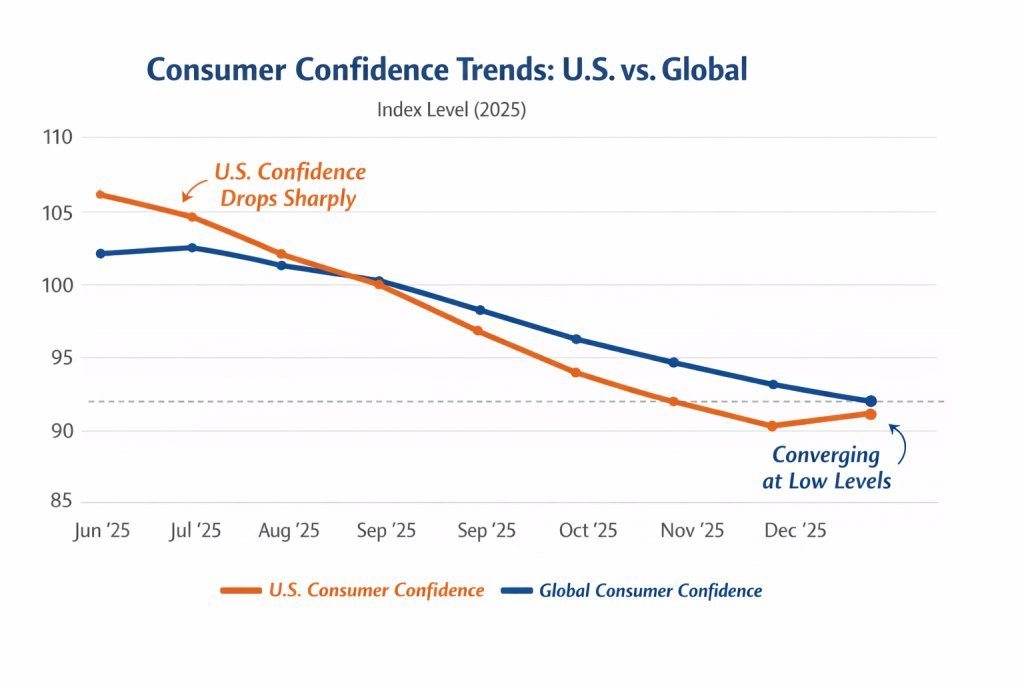
As 2025 draws to a close, one economic indicator is sending a clear signal of unease across American households: U.S. consumer confidence has fallen in December. While headline economic numbers may still suggest resilience, consumer sentiment tells a more nuanced and cautious story—one shaped by concerns over jobs, inflation, and personal financial security.
Consumer confidence is often described as a “soft” economic indicator, but its impact is anything but soft. It directly influences how people spend, save, and plan for the future. When confidence falls, it can slow economic momentum, making this decline particularly important as the country heads into 2026.
Understanding Consumer Confidence
Consumer confidence measures how optimistic or pessimistic consumers feel about the overall economy and their personal financial situation. It is commonly tracked through surveys that ask people about:
- Current business and labor market conditions
- Expectations for income, employment, and economic growth
- Willingness to make major purchases such as homes, cars, or appliances
When consumers feel secure, they tend to spend more, fueling economic growth. When they feel uncertain, they pull back—often before official data shows a slowdown.
What Happened in December?
In December 2025, consumer confidence declined for the fifth consecutive month. The drop reflects growing anxiety among households, even as the U.S. economy avoids a technical recession.
Several trends stand out:
- Fewer consumers believe jobs are plentiful
- More people say jobs are becoming harder to find
- Expectations for future income growth remain weak
- Concerns about prices and affordability persist
This combination suggests that Americans are increasingly worried not just about today, but about what the next few months may bring.
The Job Market: From Strength to Uncertainty
For much of the past two years, a strong labor market helped support consumer spending. Low unemployment and steady hiring gave workers confidence—even as inflation surged.
That confidence is now eroding.
Although unemployment remains relatively low, perceptions matter as much as reality. More Americans now feel that job opportunities are shrinking. Layoff announcements in certain industries, slower hiring, and increased automation have contributed to the belief that the labor market is losing momentum.
When people feel uncertain about job security, they delay major financial decisions. This hesitation ripples through the economy, affecting housing, retail, and service industries.
Inflation Fatigue and the Cost of Living
While inflation has cooled compared to its peak, the psychological impact of high prices lingers.
Consumers are still grappling with:
- Elevated grocery and energy costs
- High rent and housing prices
- Expensive healthcare and education
- Rising insurance and utility bills
Even when inflation slows, prices rarely return to previous levels. As a result, many households feel that their purchasing power has permanently declined. Wage growth has not fully compensated for years of higher costs, leaving consumers feeling financially squeezed.
This “inflation fatigue” plays a major role in declining confidence.
The Role of Interest Rates and Debt
High interest rates are another critical factor weighing on sentiment. Borrowing has become more expensive across the board:
- Mortgage rates remain elevated
- Auto loans cost significantly more than a few years ago
- Credit card interest rates are at historic highs
For consumers carrying debt, higher rates mean higher monthly payments. For those considering big purchases, financing costs act as a strong deterrent.
As a result, many households are prioritizing debt repayment and savings over discretionary spending—another sign of caution.
Why Confidence Is Falling Despite Economic Growth
One of the biggest puzzles of 2025 is the gap between economic data and lived experience.
| Economic Indicators | Consumer Reality |
|---|---|
| GDP growth positive | Living costs feel high |
| Inflation slowing | Prices still elevated |
| Corporate profits strong | Household finances stretched |
This gap explains why consumer confidence continues to fall even when the economy avoids worst-case scenarios. People base confidence on lived reality, not just statistics.
Why Consumer Confidence Matters So Much
Consumer spending accounts for roughly two-thirds of U.S. economic activity. When confidence weakens:
- Retail sales may slow
- Housing demand can weaken
- Business investment may decline
- Economic growth becomes more fragile
Confidence often acts as an early warning system. Prolonged declines can signal future slowdowns before they appear in employment or GDP data.
Implications for 2026
The December drop raises important questions about the year ahead.
For Policymakers
A sustained decline in confidence may increase pressure on policymakers to address affordability, job stability, and interest rates. Public sentiment often influences fiscal and monetary decisions, especially in politically sensitive periods.
For Businesses
Companies may need to prepare for more cautious consumers by:
- Offering value-focused pricing
- Avoiding aggressive expansion
- Strengthening customer loyalty
For Households
Consumers are likely to continue prioritizing:
- Savings and emergency funds
- Essential spending over discretionary purchases
- Financial stability over risk-taking
Final Thoughts
The decline in U.S. consumer confidence in December 2025 is not just a number—it’s a reflection of how Americans feel about their economic future. Concerns about jobs, inflation, debt, and affordability have combined to create a climate of caution.
While the economy has not collapsed, confidence has weakened, reminding us that economic health is as much about perception as performance. As the U.S. moves into 2026, restoring consumer confidence may prove just as important as sustaining growth itself.
How Gen Z and Young Parents are Hacking Early Retirement in 2026

The traditional image of retirement — a gold watch at 65 after decades in the same cubicle — is officially obsolete. For Gen Z and young millennial parents, the future of financial independence looks a lot different, and it’s arriving much, much sooner. We’re not talking about extreme frugality and ramen noodles for life; we’re talking about strategic, innovative approaches that are making early retirement a tangible reality by 2026 for a growing number of savvy individuals.So, how are they doing it? Let’s dive into the hacks that are redefining financial freedom for the next generation.1. The Power of the Side Hustle (and the “Stack”)It’s no secret that Gen Z are digital natives, and they’re leveraging this innate understanding to create multiple income streams. Beyond the typical Uber driving or Etsy shop, young parents are “stacking” side hustles that are scalable and often passive.Content Creation & Monetization: From TikTok influencing to niche YouTube channels about sustainable parenting or financial literacy, they’re turning their passions and expertise into significant revenue through ads, sponsorships, and affiliate marketing.Digital Products: E-books, online courses, printables for busy parents, and even customizable digital art are being created once and sold repeatedly, generating income while they sleep.Dropshipping & E-commerce: Identifying trending products and setting up online stores with minimal overhead allows them to tap into global markets without the hassle of inventory.The key here isn’t just having one side hustle, but strategically building a portfolio of income generators that can eventually replace or significantly supplement a traditional salary.2. Hyper-Efficient Saving & Investing from Day OneForget the old advice of “start saving in your 30s.” Gen Z and young parents are often beginning their investment journey as soon as they get their first paycheck, sometimes even earlier through entrepreneurial ventures.Automation is King: They’re automating savings and investments, often transferring a portion of every income stream directly into high-yield savings accounts, Roth IRAs, and diversified investment portfolios.Targeted Micro-Investing: Apps that round up purchases and invest the difference are popular, making saving feel effortless and building substantial sums over time.Understanding the “Why”: For young parents, the motivation is often amplified. They’re not just saving for themselves, but for the flexibility to spend more time with their children, provide educational opportunities, or simply create a less stressful future for their family. This strong “why” fuels consistent discipline.3. Deliberate Lifestyle Design: Experiences Over ExcessWhile stereotypes might paint Gen Z as materialistic, a significant subset is embracing a minimalist, intentional lifestyle. They’re not necessarily living in tiny homes (though some are!), but they are questioning traditional consumerism.Value-Based Spending: Instead of keeping up with the Joneses, they’re prioritizing experiences, travel, and investments in personal growth and health. Discretionary spending is carefully considered.Debt Aversion (or Aggressive Repayment): Student loan debt is a major hurdle, but many are tackling it head-on with aggressive repayment strategies, understanding that every dollar freed from debt is a dollar that can be invested towards early retirement.Geographic Arbitrage: With the rise of remote work, young professionals are opting to live in lower cost-of-living areas, allowing their income to stretch further and accelerate their savings rate. Why pay San Francisco rent when you can work remotely from a charming, affordable town and pocket the difference?4. Leveraging Technology for Financial OptimizationBeyond investment apps, this generation is using technology to dissect and optimize every aspect of their finances.Budgeting & Tracking Tools: Sophisticated apps provide real-time insights into spending habits, helping them identify areas to cut back and reallocate funds.AI-Powered Financial Advisors: Robo-advisors make sophisticated investment strategies accessible and affordable, democratizing wealth management.Community & Knowledge Sharing: Online forums, Reddit communities (like r/financialindependence), and Discord servers are vibrant hubs where young people share tips, strategies, and hold each other accountable, learning from collective wisdom.The New Face of Early RetirementBy 2026, we’ll see more and more Gen Z and young parents stepping away from the 9-to-5 grind, not because they’ve won the lottery, but because they’ve meticulously planned, innovated, and executed a strategy for financial independence. Their “retirement” might not look like endless days on a golf course; it’s more likely to involve pursuing passion projects, launching new ventures, volunteering, or simply having the freedom to raise their families on their own terms.The future of work and wealth is being rewritten, and this generation is at the forefront, proving that with the right mindset and tools, early retirement isn’t a pipe dream — it’s a perfectly achievable goal.What do you think about these strategies? Are you a young parent or Gen Z’er hacking your way to early retirement? Share your thoughts in the comments below!
Why Am I always Tired? 5 Science-Backed Ways to Boost Energy
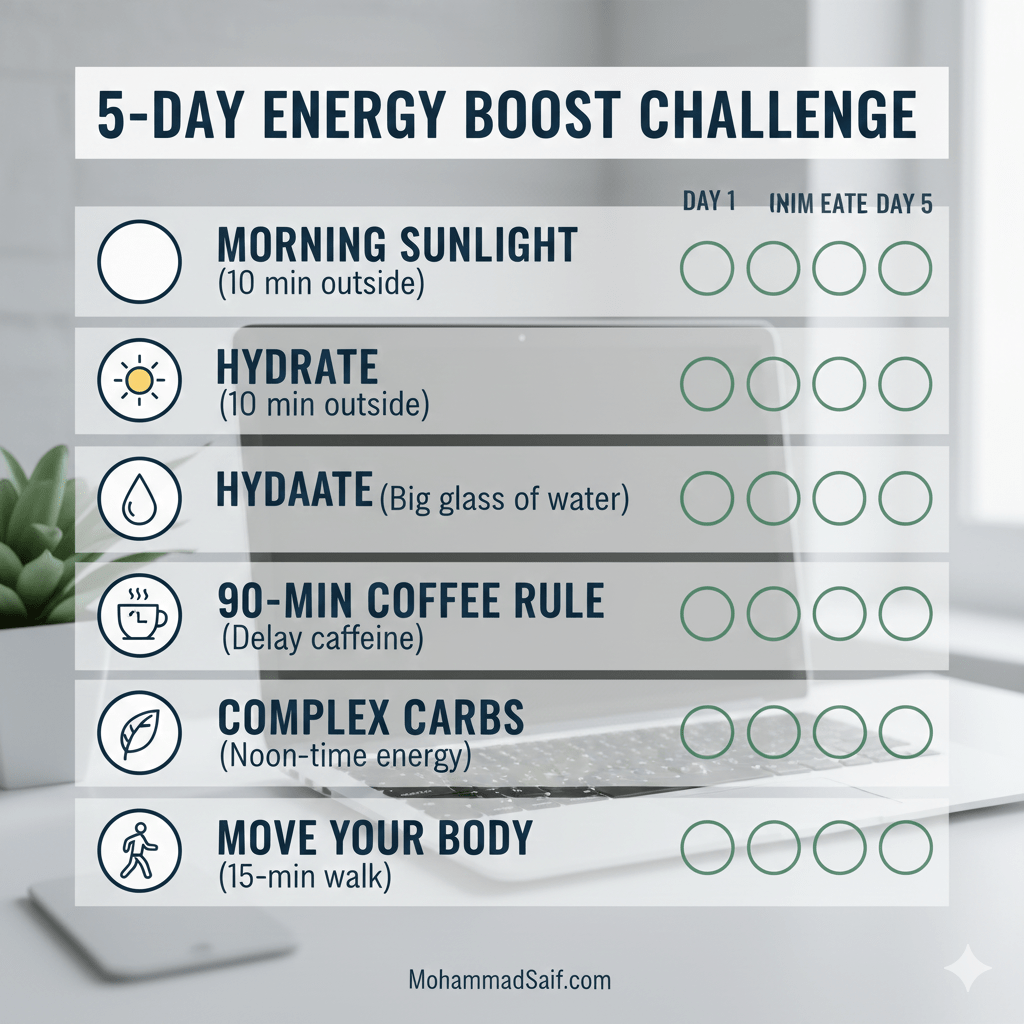
Do you wake up feeling like you never slept? Or do you hit a “wall” every day at 2:00 PM? You aren’t alone. In 2025, doctors are seeing more people than ever complaining of constant fatigue.
While it’s easy to blame a busy schedule, science shows that our energy levels are controlled by specific biological “clocks” and chemical balances. Here are five proven ways to fix them.
1. Fix Your “Internal Clock” with Morning Light
Your body has a natural rhythm called the circadian rhythm. It tells your brain when to be awake and when to be tired.
- The Science: Viewing natural sunlight within 30 minutes of waking up triggers a release of cortisol (the “alertness” hormone) and sets a timer for melatonin (the “sleep” hormone) to release later that night.
- The Fix: Step outside for 10 minutes every morning. Even a cloudy day provides more “lux” (light intensity) than your brightest indoor office lights.
2. Stop the “Glucose Rollercoaster”
That 2:00 PM crash is often caused by what you ate for lunch.
- The Science: When you eat simple carbs (white bread, sugary snacks), your blood sugar spikes and then crashes. This “crash” makes your brain feel foggy and exhausted.
- The Fix: Switch to complex carbohydrates like oats, quinoa, or nuts. These release energy slowly, keeping you steady all day.
3. Use the “90-Minute Rule” for Caffeine
Most people reach for coffee the second they wake up. Science says this is a mistake.
- The Science: When you wake up, your brain is still clearing out adenosine (a chemical that makes you feel sleepy). If you drink caffeine immediately, it blocks the clearing process, leading to a massive “caffeine crash” by noon.
- The Fix: Wait 90 minutes after waking up before having your first cup of coffee. This allows your body to naturally clear the sleepiness first.
4. Hydrate for Your Brain
Your brain is about 75% water. Even a tiny 1-2% drop in hydration can make you feel physically exhausted and mentally slow.
- The Science: Dehydration causes your blood to thicken, making your heart work harder to pump oxygen to your brain and muscles.
- The Fix: Don’t wait until you are thirsty. Drink a glass of water first thing in the morning to “restart” your system after 8 hours of fasting.
5. Movement Creates Energy
It sounds crazy: If I’m tired, why should I exercise?
- The Science: Movement increases blood flow and tells your cells to create more mitochondria—the tiny “power plants” inside your body that produce energy.
- The Fix: You don’t need a heavy gym session. A simple 15-minute brisk walk is scientifically proven to boost energy levels more effectively than a nap for most people.
When to See a Doctor
If you have tried these steps for two weeks and still feel exhausted, it might be a medical issue. Common “hidden” causes in 2025 include:
- Iron Deficiency (Anemia): Very common, especially in women.
- Vitamin D Deficiency: Many of us spend too much time indoors.
- Sleep Apnea: If you snore or wake up gasping, your brain isn’t getting enough oxygen at night.
Final Thought: Energy isn’t something you “have”—it’s something you generate. By managing your light, food, and movement, you can take control of your battery life.
iPhone 16 vs. iPhone 17: Should You Upgrade?
The new iPhone 17 is finally here! If you are using an older phone, you might be wondering: should I buy the new iPhone 17, or save money and get the iPhone 16?

In 2025, the choice is actually quite simple. Here is everything you need to know in plain English.
1. The Screen: A Big Change
This is the biggest reason to choose the iPhone 17.
- iPhone 17: Has a “ProMotion” screen. This means scrolling feels super smooth, and the screen is always on so you can see the time without touching it.
- iPhone 16: Has a standard screen. It looks good, but it doesn’t feel as “fast” or smooth when you scroll through apps.
2. Storage: More Room for Photos
Apple finally gave us more space for the same price!
- iPhone 17: Starts with 256GB of storage.
- iPhone 16: Starts with 128GB. If you take a lot of videos and photos, the iPhone 17 gives you double the room for your memories.
3. Better Selfies
If you love FaceTime or posting on social media, you’ll notice a difference.
- iPhone 17: Has a new 24MP front camera. Your face will look much sharper and clearer.
- iPhone 16: Has a 12MP camera. It’s still good, but it’s older technology.
4. Battery Life
The iPhone 17 is more efficient. Apple says it can play video for 30 hours, while the iPhone 16 lasts about 22 hours. That extra 8 hours is a big deal if you are traveling or have a long workday.
Which one should you pick?
Choose the iPhone 17 if:
- You want a screen that feels smooth and modern.
- You need more storage for your apps and photos.
- You want a phone that will stay “new” for 4 or 5 years.
Choose the iPhone 16 if:
- You want to save money (it’s much cheaper now).
- You just need a phone that works well and takes good pictures.
- You don’t care about the fancy “always-on” screen.
Final Tip: If you can afford the extra $100, the iPhone 17 is the better deal this year because of the extra storage and the smoother screen.
SEO Description for WordPress:
Wondering if you should buy the iPhone 16 or iPhone 17? We compare the screen, battery, and cameras in simple terms to help you decide which one is right for you in 2025.
How to Use Gemini and ChatGPT to Automate Your Daily Tasks
In the fast-paced world of 2025, the most valuable currency we have is time. Between managing a career, staying on top of emails, planning meals, and keeping up with personal growth, the “to-do” list often feels endless. However, the rise of AI assistants like Google Gemini and OpenAI’s ChatGPT has changed the game.
We are no longer just using AI to answer trivia; we are using it to automate the boring parts of our lives. If you aren’t using these tools to handle your daily “busy work,” you’re essentially working harder than you need to. Here is how you can use Gemini and ChatGPT to reclaim hours of your week.
1. Automating the “Digital Triage” (Emails & Messages)
The average professional spends nearly 28% of their workweek managing emails. ChatGPT and Gemini can significantly slash this time.
- The Strategy: Instead of staring at a blank screen, use the “Draft & Refine” method.
- The Prompt: “I need to tell my manager that the project will be delayed by two days due to a server issue, but I have a plan to catch up by Friday. Write this in a professional but apologetic tone.”
- Pro Tip: In Gemini, you can use the @Gmail extension to find specific emails and summarize long threads, saving you from scrolling through 50+ messages to find one piece of information.
2. Personalized Learning and “Deep Research”
Gone are the days of spending hours browsing through 10 different articles to understand a concept.
- ChatGPT’s Pulse & Deep Research: In 2025, ChatGPT has evolved to perform “agentic research.” You can ask it to “Research the top three trends in renewable energy for 2025 and provide a summary with links.” It will browse the web, verify sources, and give you a finished report.
- Gemini’s NotebookLM: If you are a student or a researcher, you can upload your PDFs to Google’s NotebookLM (powered by Gemini). It will create a “personal tutor” based on your documents, allowing you to ask questions and even generate a podcast-style audio summary of your notes to listen to while you commute.
3. Mastering the Kitchen: Meal Planning and Grocery Lists
Decision fatigue is real, especially when it comes to “What’s for dinner?”
- Automation Flow: Ask ChatGPT to create a meal plan based on your diet (e.g., High protein, 2000 calories).
- The Prompt: “Create a 7-day vegetarian meal plan. Once done, generate a categorized grocery list for these meals. Format it so I can copy-paste it into my notes app.”
- Gemini’s Edge: Since Gemini is integrated with Google Maps and Search, you can ask it to find the ingredients at the nearest grocery store or even check prices in some regions.
4. Smart Scheduling and Reminders
Managing a calendar is one of the most repetitive daily tasks. Both Gemini and ChatGPT now support Scheduled Actions.
- How it works: You can now set “Tasks” within the AI.
- Example: “Every morning at 8:00 AM, give me a briefing on the weather, my top three calendar events, and a summary of the latest AI news.”
- Integration: Gemini can directly add events to your Google Calendar or set reminders in Google Tasks. Simply say, “Gemini, schedule a meeting with Saif for tomorrow at 3:00 PM,” and it’s done—no manual entry required.
5. Coding and Technical Troubleshooting
For those in tech, automation often means writing scripts. You don’t need to be a senior developer to automate your file management or data entry.
- Python Scripts: Use ChatGPT to write a Python script that renames a batch of files, extracts data from a messy Excel sheet, or scrapes a website for prices.
- Debugging: If you have an error in your WordPress site or a snippet of code, paste it into the chat. AI can identify the syntax error in seconds, a task that might take a human 20 minutes of squinting.
6. Creative Automation: Social Media and Content
If you run a blog like Mohammad Saif, you know that social media promotion is a chore.
- Repurposing Content: Once you finish a blog post, paste the text into the AI and ask: “Create three LinkedIn posts, five Tweets, and an Instagram caption based on this blog. Use an engaging and bold tone.”
- Image Generation: Use the built-in DALL-E 3 (ChatGPT) or Imagen (Gemini) to create custom featured images for your posts, saving you from using the same overused stock photos everyone else uses.
Summary: The AI-First Mindset
The secret to automation in 2025 isn’t just knowing the tools; it’s developing an AI-first mindset. Every time you find yourself doing a task for the third time—whether it’s formatting a list, writing a follow-up email, or searching for a recipe—ask yourself: “Can Gemini or ChatGPT do this for me?”
The answer is almost always yes.
By offloading these repetitive, low-value tasks to AI, you free up your mental energy for what truly matters: creativity, strategy, and spending time with people.
SEO Meta Description for your WordPress:
Maximize your productivity in 2025! Learn how to use Google Gemini and ChatGPT to automate daily tasks, from email management and meal planning to smart scheduling and deep research.
Weekly Cost of Healthy Eating (Estimates)
The cost varies depending on your “budgeting style.” All costs assume 100% of meals are prepared at home.
| Plan Type | Individual (Adult 20–50) | Family of 4 (Ref. Family) |
| Thrifty Plan (Budget-conscious) | $57 – $72 | $231 |
| Low-Cost Plan | $62 – $72 | $253 |
| Moderate Plan | $76 – $90 | $312 |
| Liberal Plan | $96 – $109 | $376 |
Key Factors Driving 2025 Prices
- Inflation Trends: Overall food-at-home prices rose approximately 2.4% to 2.7% over the last year.1
- Location Premiums: If you live in Hawaii or Alaska, expect these costs to be 30–50% higher. States like New York and California also trend about 10–15% above the national average.
- The “Health Premium”: On average, a diet high in fresh produce and lean proteins costs about $1.50 more per day ($10.50 per week) than a diet heavy in highly processed convenience foods.
3 Ways to Lower the Cost of a Healthy Diet
- The “30-Plant” Strategy: Buying a variety of beans, lentils, and grains in bulk is often cheaper per serving than pre-packaged “health snacks.”
- Frozen over Fresh: In 2025, “flash-frozen” vegetables are considered nutritionally equivalent to fresh ones and often cost 30% less.
- Store-Brand Organics: Private labels (like Whole Foods’ 365 or Kroger’s Simple Truth) have closed the price gap with conventional brands, making organic-lifestyle habits more accessible.
Here is a targeted grocery list and the best-value protein sources to help you hit that goal.
The $60 “Thrifty” Weekly Grocery List
This list focuses on nutrient density—prioritizing fiber, healthy fats, and high protein while staying under budget.
| Category | Item (Estimated Price) | Use Case |
| Proteins | Eggs (1 doz) & Canned Tuna (2) – $7.00 | Breakfasts, salads, or quick snacks. |
| Dry Lentils or Black Beans (1lb) – $2.00 | The “anchor” for 3–4 dinners. | |
| Chicken Thighs (Family pack) – $10.00 | Versatile, cheaper than breasts. | |
| Grains | Large Oats (42oz) – $4.50 | 10+ servings of breakfast. |
| Brown Rice or Whole Wheat Pasta – $3.50 | Filling base for all main meals. | |
| Produce | Bananas & Apples – $5.00 | Daily fruit intake. |
| Large Bag Spinach or Kale – $3.50 | Greens for smoothies or sautéing. | |
| Carrots & Onions (Bulk) – $4.00 | Flavor base for soups and roasts. | |
| Frozen Mixed Veggies (2 bags) – $5.00 | Zero-waste fiber for dinners. | |
| Pantry/Dairy | Greek Yogurt (Large tub) – $5.50 | High-protein snack or sour cream sub. |
| Peanut Butter (Jar) – $3.00 | Healthy fats and extra protein. | |
| Total Estimated Weekly Spend | ~$53.00 (leaving $7 for tax/spices) |
Best Value High-Protein Foods (2025–2026 Trends)
If your goal is to maximize protein per dollar, these are your “Big 5” winners for the coming year:
- Dry Legumes (Lentils/Chickpeas): Still the undisputed king of value. You get roughly 18g of protein per cup for pennies.
- Eggs: Despite price fluctuations in 2024, eggs remain the most bioavailable, low-cost “complete” protein in 2025.
- Canned Sardines/Mackerel: High in Omega-3s and protein. They are more shelf-stable and often cheaper than fresh fish.
- Store-Brand Greek Yogurt: In 2025, retailers have improved their “Private Label” formulas, offering high protein counts (approx. 15–18g per serving) at 40% less than name brands.
- Cottage Cheese: Currently trending for its “whippable” texture, it provides nearly 25g of protein per cup and is often on sale as a dairy staple.
Pro-Tip for 2026: The “Frozen First” Rule
By 2026, supply chain optimizations for frozen produce are expected to make frozen “Super-Greens” (like frozen edamame and chopped kale) up to 50% cheaper than fresh, with the same nutritional profile.
Let’s turn that $60 grocery list into a streamlined 7-Day Meal Prep Plan.
This plan uses the “Cook Once, Eat Twice” philosophy to save you time during the week while ensuring you hit your protein and fiber goals.
The 7-Day “Thrifty & Healthy” Plan
| Meal | Mon – Wed | Thu – Fri | Sat – Sun (Fresh Days) |
| Breakfast | Overnight Oats: Oats, Greek yogurt, peanut butter, and a few frozen berries. | Warm Savory Oats: Oats cooked with an egg swirled in and sautéed spinach. | Greek Yogurt Bowl with fresh apples and a drizzle of peanut butter. |
| Lunch | Tuna Salad Wraps/Bowls: Canned tuna mixed with Greek yogurt (sub for mayo), carrots, and onions over rice. | Lentil Power Bowls: Large batch of lentils, brown rice, and frozen mixed veggies. | Egg & Greens Scramble: 3 eggs, sautéed onions, and a large handful of spinach. |
| Dinner | Sheet Pan Chicken: Roasted chicken thighs with carrots, onions, and broccoli. | Black Bean Stir-Fry: Sautéed black beans, onions, and frozen veggies over rice. | “Kitchen Sink” Soup: Use the remaining chicken, lentils, and all leftover veggies. |
| Snack | Apple slices with peanut butter. | A hard-boiled egg. | Greek yogurt with a banana. |
3 Tips to Make This Work
- Batch Cook on Sunday: Cook your entire bag of brown rice and your bag of lentils all at once. Keep them in the fridge to use as a “base” for every lunch and dinner.
- The Yogurt Swap: Notice we aren’t buying mayo or sour cream. Plain Greek yogurt is your “Swiss Army Knife”—it works as a high-protein substitute in tuna salad, on top of black beans, or as a breakfast base.
- Seasoning is Key: Since this is a “Thrifty” plan, use the $7 leftover in the budget for a versatile spice like Smoked Paprika or Garlic Powder to keep the meals from feeling repetitive.
Here is the latest news and the official guidelines for the holiday.
It is currently December 25, 2025, and Christmas Day celebrations are in full swing across the United States. This year is particularly notable as the date 12/25/25 is a once-in-a-century mathematical “match.”
🎄 Christmas Day 2025: Top News Stories
1. Record-Breaking Warmth
This is forecast to be the warmest Christmas on record for the contiguous United States. Average highs are hitting $54^{\circ}F$ ($12^{\circ}C$), shattering the previous 2005 record. While the Northeast is seeing some snow, states from California to Indiana are experiencing “T-shirt weather” with temperatures 15–35 degrees above average.
2. The “Federal Bridge” Holiday
In a major move, President Trump issued an executive order declaring both December 24 and December 26 as federal holidays for 2025. This has given federal employees a rare 4-day weekend, though most private-sector businesses remain open today or tomorrow.
3. Travel Chaos: Storms & Flooding
While much of the country is warm, travel has been difficult:
- West Coast: Heavy storms and “atmospheric rivers” have triggered flood watches for 41 million people in California, Nevada, and Arizona.
- Northeast: Fast-moving “clipper” storms are bringing snow and freezing rain to New England, causing significant flight delays at JFK, Logan, and Newark.
4. “Warrior Dividend” and Incentives
The administration recently announced a $1,776 “Warrior Dividend” payout for every US soldier as a Christmas thank-you. Additionally, a controversial “mega incentive” of $2.7$ Lakh (approx. $3,000$) was announced for undocumented migrants who choose to leave the US voluntarily this week.
🛡️ Official Celebration Guidelines & Safety
If you are hosting or traveling today, authorities (CPSC, Red Cross, and TSA) have issued these specific guidelines:
Home & Fire Safety
- The 3-Foot Rule: Keep your Christmas tree and any flammable decorations at least 3 feet away from fireplaces, space heaters, and candles.
- Hydrate Your Tree: If you have a live tree, it is now at its driest. Add water daily. Dry trees can engulfed a room in flames in less than 30 seconds.
- Power Strips: Never plug more than three strings of incandescent lights into each other; use a power strip with a surge protector instead.
Health & Kitchen Safety
- “Turn Handles In”: When cooking large holiday meals, turn pot handles toward the back of the stove to prevent children from pulling hot liquids onto themselves.
- Cardiac Awareness: Doctors warn of “Holiday Heart Syndrome.” Cold weather, high-sodium meals, and alcohol can spike heart attack risks. If you feel chest pressure or shortness of breath, call 911 immediately.
- Pet Alerts: Keep chocolate, lilies, mistletoe, and cooked bones away from pets, as these are common causes of emergency vet visits on Christmas Day.
Travel Advice
- Monitor Apps: With 44 million people traveling, use airline apps to track delays caused by the California floods or New England snow.
- Emergency Kit: If driving in the Northeast or Midwest, ensure your car has a blanket, flashlight, and salt/sand for icy patches.
Christmas Across Europe: A Magical Tour Through the Continent’s Festive Capitals
As December descends, Europe transforms into a winter wonderland, each city glowing with its unique festive charm. While the spirit of Christmas unites the continent, the traditions, markets, and culinary delights vary dramatically from one capital to another.
Join us on a virtual tour of Christmas celebrations across some of Europe’s most iconic cities!
1. London, United Kingdom: A Quintessential British Christmas
London during Christmas is a spectacle of lights and traditional cheer.
- Oxford Street & Regent Street Lights: The dazzling light displays on these iconic shopping streets are world-famous, often accompanied by elaborate window displays from department stores like Harrods and Selfridges.
- Hyde Park Winter Wonderland: This massive annual event features ice skating, thrilling rides, festive markets, and live entertainment, making it a must-visit for families.
- Carol Singing: The tradition of carol singing is strong, with performances in Trafalgar Square around the giant Christmas tree (a gift from Norway) and in Westminster Abbey.
- Pantomimes: A unique British tradition, these comedic musical plays are a beloved holiday pastime for all ages.
2. Paris, France: Noël à la Ville Lumière
Paris, the City of Lights, becomes even more enchanting during the festive season.
- Champs-Élysées Lights: The grand avenue is illuminated with spectacular displays, leading up to the Arc de Triomphe, creating an unforgettable evening stroll.
- Marchés de Noël: Traditional Christmas markets pop up across the city, most notably in La Défense, offering artisanal crafts, gourmet treats like vin chaud (mulled wine) and châtaignes grillées (roasted chestnuts).
- Galeries Lafayette Dome: The iconic department store’s stunning Art Nouveau dome houses an elaborate, often whimsical, Christmas tree that draws crowds.
- Ice Skating: Temporary ice rinks emerge in picturesque locations, like the one often found outside the Hôtel de Ville.
3. Berlin, Germany: A Historic & Heartfelt Weihnachten
Germany is the birthplace of many Christmas traditions, and Berlin embraces them with gusto.
- Numerous Christmas Markets: Berlin boasts over 100 Christmas markets, each with its own character. The market at Gendarmenmarkt is particularly beautiful, known for its crafts and gourmet food, while Charlottenburg Palace offers a majestic backdrop.
- Glühwein & Bratwurst: These staples are found at every market, providing warmth and flavor against the winter chill.
- Festive Events: From classical concerts to special holiday services in the Berlin Cathedral, the city offers a rich cultural experience.
- Brandenburg Gate: While not decorated in the traditional sense, the Gate often serves as a focal point for festive gatherings and New Year’s Eve celebrations.
4. Vienna, Austria: An Imperial Christmas Fairytale
Vienna’s imperial architecture provides a breathtaking setting for its Christmas celebrations.
- Christkindlmarkt at Rathausplatz: The most famous market, set in front of Vienna’s City Hall, is a fairytale of twinkling lights, traditional crafts, and delicious treats like Lebkuchen (gingerbread).
- Schönbrunn Palace Market: The baroque splendor of Schönbrunn Palace hosts a charming cultural market, perfect for unique gifts.
- Classical Concerts: Vienna, the city of music, offers an abundance of classical Christmas concerts in historic venues.
- Ice Dream: After Christmas, the area around Rathausplatz transforms into a huge ice-skating rink, Wiener Eistraum, adding another layer of winter magic.
5. Rome, Italy: Natale in the Eternal City
Christmas in Rome combines ancient history with heartfelt religious traditions.
- St. Peter’s Square: The Vatican is the spiritual heart of Catholic Christmas, featuring a massive Christmas tree and a life-sized Nativity scene (presepe). Midnight Mass in St. Peter’s Basilica is a profound experience.
- Piazza Navona Market: Traditionally, this piazza hosts a lively Christmas market with toys, sweets, and carousel rides.
- Via del Corso Lights: Rome’s main shopping street is adorned with elegant lights, creating a festive atmosphere for shoppers.
- Presepi Everywhere: Nativity scenes are central to Italian Christmas, displayed in churches, homes, and public spaces throughout the city.
**Which European city’s Christmas celebration sounds most appealing to you?**

Here is a quick guide to what is open and closed today across the USA.
Since today is Christmas Day (December 25, 2025), most major retailers and grocery stores are closed to allow employees to spend time with their families. However, if you need last-minute medicine, snacks, or a hot meal, there are still several options available.
Here is a quick guide to what is open and closed today across the USA.
🏪 Retailers & Pharmacy Stores (Open Today)
While giants like Walmart, Target, and Costco are closed today, these convenience and drug stores are typically open:
- Walgreens: Most stores are open (many from 9:00 AM to 5:00 PM), though pharmacy hours vary by location. All 24-hour locations remain open 24/7.
- CVS Pharmacy: Most locations are open today, but many are operating with reduced holiday hours. Check the CVS app before heading out.
- 7-Eleven: Most locations remain open 24/7, including today. This is your best bet for emergency milk, eggs, or snacks.
- Circle K / Safeway / Albertsons: Many of these locations are open today with modified hours.
🍔 Restaurants & Fast Food (Open Today)
Most standalone fast-food restaurants are independently owned, so hours vary by neighborhood. Pro-tip: Use the brand’s mobile app to see if your local branch is active.
- McDonald’s: Many locations are open today, particularly those in travel hubs or city centers. Expect drive-thru only at some spots.
- Starbucks: Many stores are open with limited morning/afternoon hours (e.g., closing by 2:00 PM or 4:00 PM).
- Dunkin’: Most locations are open today, but hours are determined by the individual franchise.
- Waffle House / Denny’s / IHOP: These “sit-down” favorites are famous for staying open 24/7, 365 days a year, including today.
- Red Lobster: Open today (typically 11:00 AM to 8:00 PM) at many locations for those wanting a non-traditional holiday dinner.
🚫 Major Stores Closed Today
The following will be fully closed on December 25 and will reopen on December 26:
- Walmart (Reopens Dec 26 at 6:00 AM)
- Target (Reopens Dec 26 at 7:00 AM)
- Costco
- Aldi / Trader Joe’s / Whole Foods
- Home Depot / Lowe’s
- Macy’s / JCPenney
💡 Quick Tip for You
Since it is an unseasonably warm Christmas in much of the country, many people are heading to parks. If you’re doing the same, remember that public restrooms in government-run parks may be closed today due to the federal holiday.
Will Dream11 and My11Circle Allow Paid Contests in IPL 2026? Understanding the Government’s Gaming Bill
As the countdown to IPL 2026 begins, millions of cricket fans and fantasy players are asking one critical question: Will we be able to play paid contests again?
The year 2025 was a “reset” for the Indian gaming industry. Following the passage of a landmark bill, heavyweights like Dream11 and My11Circle were forced to pivot their entire business models. Here is everything you need to know about the legal status of paid fantasy sports and the government’s current stance.
The Current Status: Can You Play Paid Contests?
As of late 2025, the answer is no. Following the implementation of the Promotion and Regulation of Online Gaming Act, 2025 (PROGA), major platforms including Dream11 and My11Circle suspended their real-money paid contests.
- Dream11’s Pivot: The platform transitioned into a “free-to-play” social game. While you can still create teams and compete for rankings, the high-stakes cash prizes that once defined the IPL season are currently off the table.
- My11Circle’s Stance: Similarly, My11Circle suspended its paid games to comply with the new federal regulations, prioritizing player safety and legal compliance.
The Government’s Stand: The 2025 Gaming Bill
The Promotion and Regulation of Online Gaming Act, 2025, marked a dramatic change in how India views digital gaming. Here are the three pillars of the government’s stance:
- A Blanket Ban on “Money Games”: The government removed the long-standing distinction between “games of skill” (like fantasy sports) and “games of chance.” Under the new law, any online game involving stakes/money in exchange for cash prizes is prohibited.
- Social Protection: Union Minister Ashwini Vaishnaw highlighted that the bill was necessary to protect the youth from financial distress, addiction, and “predatory” algorithms.
- Promotion of E-sports: Interestingly, the bill is not “anti-gaming.” It actively promotes e-sports and educational social games. The government aims to make India a global hub for game development, just not for real-money wagering.
What to Expect for IPL 2026?
Will the “Mega Contests” return by the time the first ball is bowled in IPL 2026?
- The Supreme Court Factor: Several gaming federations and companies have challenged the 2025 Act in the Supreme Court, arguing that it violates the constitutional right to practice a legitimate profession. If the Court grants a “stay” or rules the ban on “skill games” unconstitutional, paid contests could return overnight.
- The Free-to-Play Model: For now, expect Dream11 and My11Circle to focus on sponsored rewards (merchandise, tickets, or brand vouchers) rather than direct cash payouts to keep users engaged during the IPL.
Summary of Penalties under the New Law
| Feature | Penalty for Violation |
| Operating Paid Games | Up to 3 years in jail and ₹1 Crore fine. |
| Advertising Banned Apps | Up to 2 years in jail and ₹50 Lakh fine. |
| Repeat Offenders | Up to 5 years in jail and ₹2 Crore fine. |
The Bottom Line: Unless there is a major judicial intervention before April 2026, IPL 2026 will likely be the first season played entirely on a “Free-to-Play” basis on these major platforms.
As we head toward IPL 2026, the fantasy cricket world is buzzing with questions about how to stay involved. While the new gaming laws have shifted the focus away from direct cash entries, the thrill of the game isn’t gone—it’s just changing.
Here is a list of alternative ways to engage and win rewards during the upcoming season:
1. Free-to-Play “Mega Leagues”
Major apps like Dream11 and My11Circle have introduced high-reward free contests. Instead of cash, you compete for:
- Physical Prizes: High-end smartphones, luxury watches, and even cars.
- Match Tickets: Exclusive VIP passes and hospitality tickets for IPL 2026 matches.
- Official Merchandise: Signed jerseys, bats, and team kits.
2. The “Token” and Loyalty System
Expect platforms to lean heavily on digital currencies (like Dream11 “Dream Coins”).
- How it works: You earn tokens by joining free contests, logging in daily, or completing “milestone challenges.”
- The Reward: These tokens can be redeemed in an integrated marketplace for brand vouchers (Amazon, Zomato, etc.) or “boosters” for your next team.
3. Sponsored Brand Challenges
Brands are now “powering” specific contests. For example:
- The [Brand] Power Play: A free contest where the winner gets a year-long subscription or shopping credit from the sponsoring brand.
- Predictor Games: Simple “Yes/No” or “Pick the Winner” games on WhatsApp or social media that offer instant cashback or discount coupons.
4. Season-Long “Social” Leagues
Since the “per-match” cash thrill is restricted, there is a massive shift toward private leagues with friends.
- Apps are making it easier to create “Bragging Rights” leagues.
- The Draw: It’s no longer about winning ₹50; it’s about being at the top of your office or family leaderboard for the entire 2-month tournament.
5. Fan Polls and Interactive Quizzes
Official platforms like IPLT20.com and team apps (like the Rajasthan Royals’ WhatsApp Bot) are launching interactive tools:
- Live Polls: Voting for “Player of the Match” to win small digital rewards.
- Trivia Challenges: Testing your cricket knowledge in real-time during the strategic timeouts for points.
Comparison of the “New Era” of Fantasy
| Feature | Old Model (Pre-2025) | New Model (IPL 2026) |
| Entry Fee | Paid (Cash) | Free / Token-based |
| Main Reward | Cash Payouts | Tech, Travel, & Vouchers |
| Legal Risk | High (State-specific bans) | Low (Government compliant) |
| Primary Focus | Financial Gain | Entertainment & Community |
How Coffee Affects Your Body: The Science Behind Your Daily Brew
For many of us, the day doesn’t truly begin until that first sip of coffee hits our system. It’s a ritual, a comfort, and a survival tool all rolled into one. But beyond the immediate “wake-up” call, what is that cup of joe actually doing to your biology?
The impact of coffee is a complex mix of short-term stimulation and long-term health benefits. Let’s break down how your favorite morning beverage travels through your body.
1. The Brain: The Adenosine Hijack
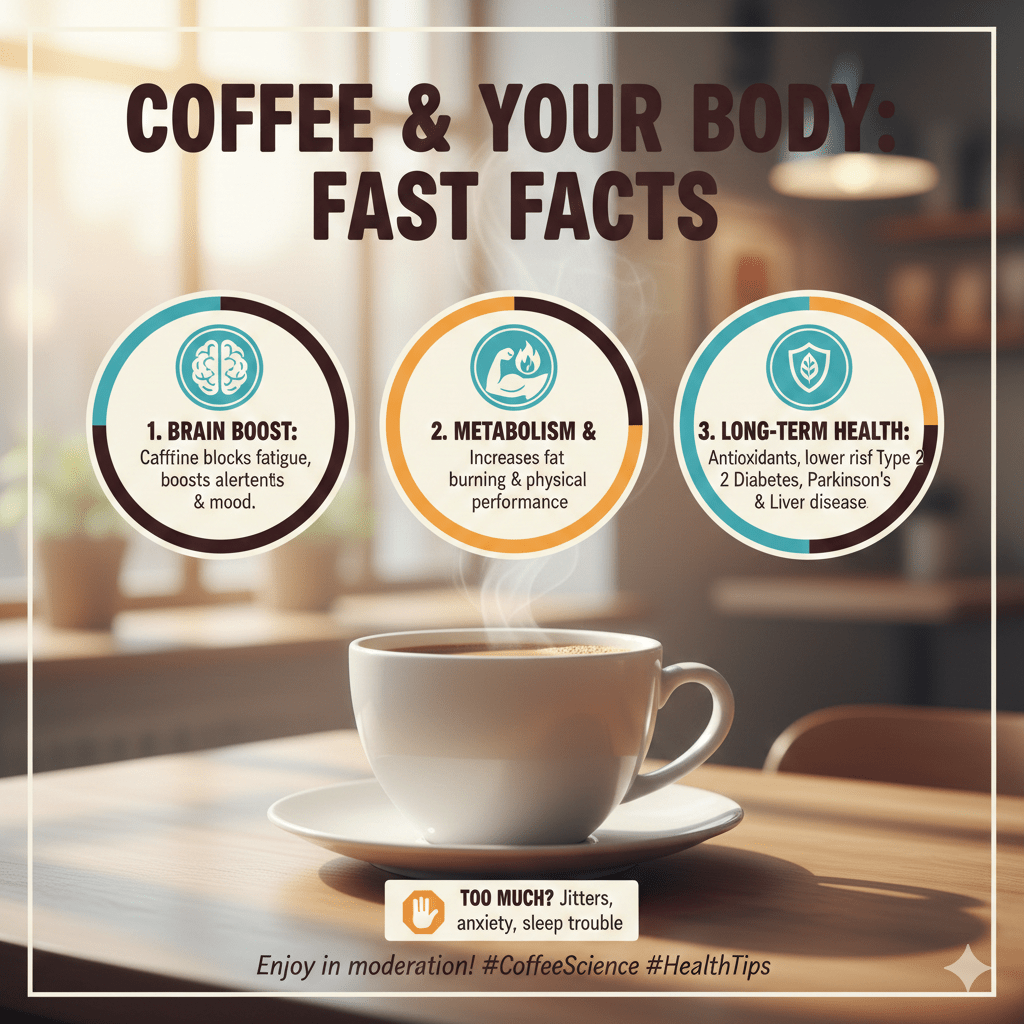
The most famous effect of coffee happens in your brain. Coffee contains caffeine, which is structurally similar to a molecule called adenosine.
- The Process: Throughout the day, adenosine builds up in your brain, binding to receptors that tell your body it’s time to feel tired.
- The Switch: Caffeine enters the brain and “plugs” those receptors, preventing adenosine from doing its job.
- The Result: Instead of feeling drowsy, you experience a surge of alertness and dopamine, which improves mood and cognitive function.
2. The Heart and Metabolism
Within 15 to 45 minutes of drinking coffee, your metabolism gets a temporary kickstart.
- Adrenaline Spike: Caffeine signals your adrenal glands to release adrenaline (epinephrine). This can slightly increase your heart rate and open up airways.
- Fat Burning: Studies show that caffeine can increase your metabolic rate by 3% to 11%, helping the body mobilize fats from fat tissues.
- Physical Performance: By increasing adrenaline levels, coffee prepares your body for intense physical exertion, which is why it’s a popular “pre-workout” drink.
3. Digestion and the Gut
Have you ever noticed that coffee sends you straight to the bathroom? You aren’t imagining it. Coffee stimulates the release of gastrin, a hormone that speeds up activity in the colon. It also triggers the release of digestive enzymes in the stomach, which can help (or sometimes hinder) digestion depending on your sensitivity.
4. Long-Term Health Benefits
When consumed in moderation (typically 3–4 cups a day), coffee has been linked to several impressive long-term protective effects:
| Benefit Type | Potential Impact |
| Brain Health | May lower the risk of Alzheimer’s and Parkinson’s disease. |
| Liver Protection | Linked to a significantly lower risk of liver cirrhosis and liver cancer. |
| Type 2 Diabetes | Regular drinkers often show a reduced risk of developing insulin resistance. |
| Antioxidants | For many people in Western diets, coffee is a primary source of inflammation-fighting antioxidants. |
The “Fine Print”: When to Be Careful
While coffee is generally a health win, it isn’t for everyone. Excessive intake can lead to:
- Anxiety and Jitters: Too much caffeine can overstimulate the “fight or flight” response.
- Sleep Disruption: Caffeine has a half-life of about 5–6 hours. That 4:00 PM espresso might still be in your system at midnight.
- Acid Reflux: Coffee is acidic and can relax the lower esophageal sphincter, leading to heartburn.
Final Thoughts
Coffee is more than just a caffeine delivery system; it’s a biologically active beverage that influences everything from your DNA repair to your digestive speed. If you enjoy your coffee black or with a splash of milk, you’re likely doing your body a favor. Just keep an eye on the added sugars and your “cutoff time” for caffeine to ensure you get the benefits without the burnout.
Achievements
Mohammad Saif is a student of masters and is Passionate about blockchain and crypto’s. He also follow start-up’s and is very passionate about the technology. I started this blog to share some useful knowledge about crypto’s and blockchain. I will also write on start-up’s.

