Economy

U.S. Consumer Confidence Drops in December: What It Reveals About the Economy and What Lies Ahead

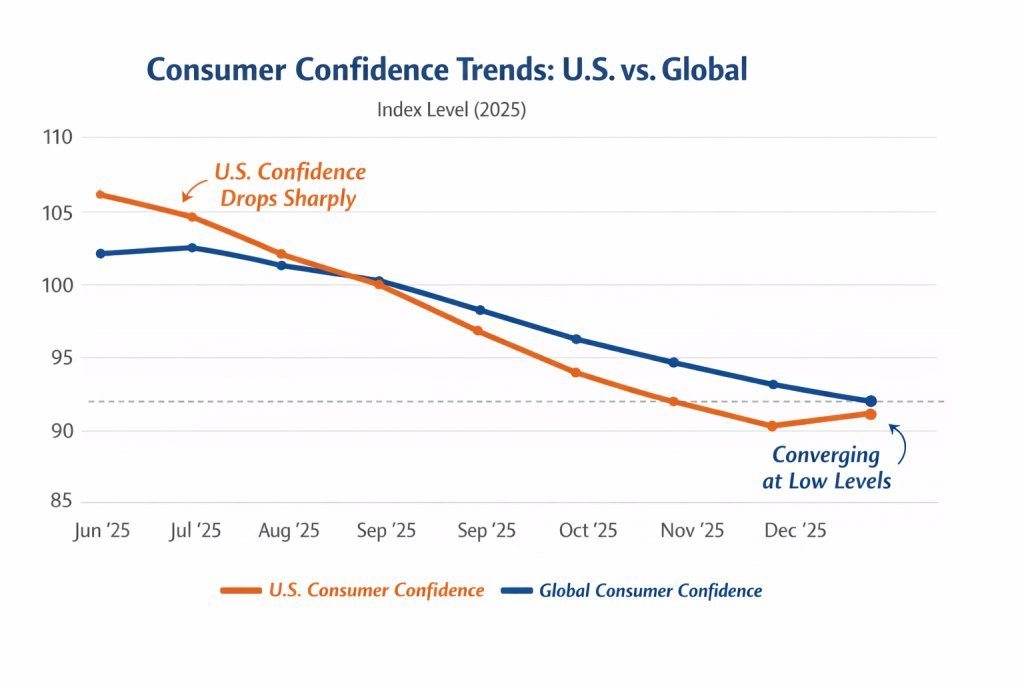
As 2025 draws to a close, one economic indicator is sending a clear signal of unease across American households: U.S. consumer confidence has fallen in December. While headline economic numbers may still suggest resilience, consumer sentiment tells a more nuanced and cautious story—one shaped by concerns over jobs, inflation, and personal financial security.

Consumer confidence is often described as a “soft” economic indicator, but its impact is anything but soft. It directly influences how people spend, save, and plan for the future. When confidence falls, it can slow economic momentum, making this decline particularly important as the country heads into 2026.


Understanding Consumer Confidence

Consumer confidence measures how optimistic or pessimistic consumers feel about the overall economy and their personal financial situation. It is commonly tracked through surveys that ask people about:

  • Current business and labor market conditions
  • Expectations for income, employment, and economic growth
  • Willingness to make major purchases such as homes, cars, or appliances

When consumers feel secure, they tend to spend more, fueling economic growth. When they feel uncertain, they pull back—often before official data shows a slowdown.


What Happened in December?

In December 2025, consumer confidence declined for the fifth consecutive month. The drop reflects growing anxiety among households, even as the U.S. economy avoids a technical recession.

Several trends stand out:

  • Fewer consumers believe jobs are plentiful
  • More people say jobs are becoming harder to find
  • Expectations for future income growth remain weak
  • Concerns about prices and affordability persist

This combination suggests that Americans are increasingly worried not just about today, but about what the next few months may bring.


The Job Market: From Strength to Uncertainty

For much of the past two years, a strong labor market helped support consumer spending. Low unemployment and steady hiring gave workers confidence—even as inflation surged.

That confidence is now eroding.

Although unemployment remains relatively low, perceptions matter as much as reality. More Americans now feel that job opportunities are shrinking. Layoff announcements in certain industries, slower hiring, and increased automation have contributed to the belief that the labor market is losing momentum.

When people feel uncertain about job security, they delay major financial decisions. This hesitation ripples through the economy, affecting housing, retail, and service industries.


Inflation Fatigue and the Cost of Living

While inflation has cooled compared to its peak, the psychological impact of high prices lingers.

Consumers are still grappling with:

  • Elevated grocery and energy costs
  • High rent and housing prices
  • Expensive healthcare and education
  • Rising insurance and utility bills

Even when inflation slows, prices rarely return to previous levels. As a result, many households feel that their purchasing power has permanently declined. Wage growth has not fully compensated for years of higher costs, leaving consumers feeling financially squeezed.

This “inflation fatigue” plays a major role in declining confidence.


The Role of Interest Rates and Debt

High interest rates are another critical factor weighing on sentiment. Borrowing has become more expensive across the board:

  • Mortgage rates remain elevated
  • Auto loans cost significantly more than a few years ago
  • Credit card interest rates are at historic highs

For consumers carrying debt, higher rates mean higher monthly payments. For those considering big purchases, financing costs act as a strong deterrent.

As a result, many households are prioritizing debt repayment and savings over discretionary spending—another sign of caution.


Why Confidence Is Falling Despite Economic Growth

One of the biggest puzzles of 2025 is the gap between economic data and lived experience.

Economic IndicatorsConsumer Reality
GDP growth positiveLiving costs feel high
Inflation slowingPrices still elevated
Corporate profits strongHousehold finances stretched

This gap explains why consumer confidence continues to fall even when the economy avoids worst-case scenarios. People base confidence on lived reality, not just statistics.


Why Consumer Confidence Matters So Much

Consumer spending accounts for roughly two-thirds of U.S. economic activity. When confidence weakens:

  • Retail sales may slow
  • Housing demand can weaken
  • Business investment may decline
  • Economic growth becomes more fragile

Confidence often acts as an early warning system. Prolonged declines can signal future slowdowns before they appear in employment or GDP data.


Implications for 2026

The December drop raises important questions about the year ahead.

For Policymakers

A sustained decline in confidence may increase pressure on policymakers to address affordability, job stability, and interest rates. Public sentiment often influences fiscal and monetary decisions, especially in politically sensitive periods.

For Businesses

Companies may need to prepare for more cautious consumers by:

  • Offering value-focused pricing
  • Avoiding aggressive expansion
  • Strengthening customer loyalty

For Households

Consumers are likely to continue prioritizing:

  • Savings and emergency funds
  • Essential spending over discretionary purchases
  • Financial stability over risk-taking

Final Thoughts

The decline in U.S. consumer confidence in December 2025 is not just a number—it’s a reflection of how Americans feel about their economic future. Concerns about jobs, inflation, debt, and affordability have combined to create a climate of caution.

While the economy has not collapsed, confidence has weakened, reminding us that economic health is as much about perception as performance. As the U.S. moves into 2026, restoring consumer confidence may prove just as important as sustaining growth itself.


Uncategorized

How Gen Z and Young Parents are Hacking Early Retirement in 2026

The traditional image of retirement — a gold watch at 65 after decades in the same cubicle — is officially obsolete. For Gen Z and young millennial parents, the future of financial independence looks a lot different, and it’s arriving much, much sooner. We’re not talking about extreme frugality and ramen noodles for life; we’re talking about strategic, innovative approaches that are making early retirement a tangible reality by 2026 for a growing number of savvy individuals.So, how are they doing it? Let’s dive into the hacks that are redefining financial freedom for the next generation.1. The Power of the Side Hustle (and the “Stack”)It’s no secret that Gen Z are digital natives, and they’re leveraging this innate understanding to create multiple income streams. Beyond the typical Uber driving or Etsy shop, young parents are “stacking” side hustles that are scalable and often passive.Content Creation & Monetization: From TikTok influencing to niche YouTube channels about sustainable parenting or financial literacy, they’re turning their passions and expertise into significant revenue through ads, sponsorships, and affiliate marketing.Digital Products: E-books, online courses, printables for busy parents, and even customizable digital art are being created once and sold repeatedly, generating income while they sleep.Dropshipping & E-commerce: Identifying trending products and setting up online stores with minimal overhead allows them to tap into global markets without the hassle of inventory.The key here isn’t just having one side hustle, but strategically building a portfolio of income generators that can eventually replace or significantly supplement a traditional salary.2. Hyper-Efficient Saving & Investing from Day OneForget the old advice of “start saving in your 30s.” Gen Z and young parents are often beginning their investment journey as soon as they get their first paycheck, sometimes even earlier through entrepreneurial ventures.Automation is King: They’re automating savings and investments, often transferring a portion of every income stream directly into high-yield savings accounts, Roth IRAs, and diversified investment portfolios.Targeted Micro-Investing: Apps that round up purchases and invest the difference are popular, making saving feel effortless and building substantial sums over time.Understanding the “Why”: For young parents, the motivation is often amplified. They’re not just saving for themselves, but for the flexibility to spend more time with their children, provide educational opportunities, or simply create a less stressful future for their family. This strong “why” fuels consistent discipline.3. Deliberate Lifestyle Design: Experiences Over ExcessWhile stereotypes might paint Gen Z as materialistic, a significant subset is embracing a minimalist, intentional lifestyle. They’re not necessarily living in tiny homes (though some are!), but they are questioning traditional consumerism.Value-Based Spending: Instead of keeping up with the Joneses, they’re prioritizing experiences, travel, and investments in personal growth and health. Discretionary spending is carefully considered.Debt Aversion (or Aggressive Repayment): Student loan debt is a major hurdle, but many are tackling it head-on with aggressive repayment strategies, understanding that every dollar freed from debt is a dollar that can be invested towards early retirement.Geographic Arbitrage: With the rise of remote work, young professionals are opting to live in lower cost-of-living areas, allowing their income to stretch further and accelerate their savings rate. Why pay San Francisco rent when you can work remotely from a charming, affordable town and pocket the difference?4. Leveraging Technology for Financial OptimizationBeyond investment apps, this generation is using technology to dissect and optimize every aspect of their finances.Budgeting & Tracking Tools: Sophisticated apps provide real-time insights into spending habits, helping them identify areas to cut back and reallocate funds.AI-Powered Financial Advisors: Robo-advisors make sophisticated investment strategies accessible and affordable, democratizing wealth management.Community & Knowledge Sharing: Online forums, Reddit communities (like r/financialindependence), and Discord servers are vibrant hubs where young people share tips, strategies, and hold each other accountable, learning from collective wisdom.The New Face of Early RetirementBy 2026, we’ll see more and more Gen Z and young parents stepping away from the 9-to-5 grind, not because they’ve won the lottery, but because they’ve meticulously planned, innovated, and executed a strategy for financial independence. Their “retirement” might not look like endless days on a golf course; it’s more likely to involve pursuing passion projects, launching new ventures, volunteering, or simply having the freedom to raise their families on their own terms.The future of work and wealth is being rewritten, and this generation is at the forefront, proving that with the right mindset and tools, early retirement isn’t a pipe dream — it’s a perfectly achievable goal.What do you think about these strategies? Are you a young parent or Gen Z’er hacking your way to early retirement? Share your thoughts in the comments below!

Tech

iPhone 16 vs. iPhone 17: Should You Upgrade?


The new iPhone 17 is finally here! If you are using an older phone, you might be wondering: should I buy the new iPhone 17, or save money and get the iPhone 16?

In 2025, the choice is actually quite simple. Here is everything you need to know in plain English.

1. The Screen: A Big Change

This is the biggest reason to choose the iPhone 17.

  • iPhone 17: Has a “ProMotion” screen. This means scrolling feels super smooth, and the screen is always on so you can see the time without touching it.
  • iPhone 16: Has a standard screen. It looks good, but it doesn’t feel as “fast” or smooth when you scroll through apps.

2. Storage: More Room for Photos

Apple finally gave us more space for the same price!

  • iPhone 17: Starts with 256GB of storage.
  • iPhone 16: Starts with 128GB. If you take a lot of videos and photos, the iPhone 17 gives you double the room for your memories.

3. Better Selfies

If you love FaceTime or posting on social media, you’ll notice a difference.

  • iPhone 17: Has a new 24MP front camera. Your face will look much sharper and clearer.
  • iPhone 16: Has a 12MP camera. It’s still good, but it’s older technology.

4. Battery Life

The iPhone 17 is more efficient. Apple says it can play video for 30 hours, while the iPhone 16 lasts about 22 hours. That extra 8 hours is a big deal if you are traveling or have a long workday.


Which one should you pick?

Choose the iPhone 17 if:

  • You want a screen that feels smooth and modern.
  • You need more storage for your apps and photos.
  • You want a phone that will stay “new” for 4 or 5 years.

Choose the iPhone 16 if:

  • You want to save money (it’s much cheaper now).
  • You just need a phone that works well and takes good pictures.
  • You don’t care about the fancy “always-on” screen.

Final Tip: If you can afford the extra $100, the iPhone 17 is the better deal this year because of the extra storage and the smoother screen.


SEO Description for WordPress:

Wondering if you should buy the iPhone 16 or iPhone 17? We compare the screen, battery, and cameras in simple terms to help you decide which one is right for you in 2025.

Uncategorized

Here is the latest news and the official guidelines for the holiday.

It is currently December 25, 2025, and Christmas Day celebrations are in full swing across the United States. This year is particularly notable as the date 12/25/25 is a once-in-a-century mathematical “match.”


🎄 Christmas Day 2025: Top News Stories

1. Record-Breaking Warmth

This is forecast to be the warmest Christmas on record for the contiguous United States. Average highs are hitting $54^{\circ}F$ ($12^{\circ}C$), shattering the previous 2005 record. While the Northeast is seeing some snow, states from California to Indiana are experiencing “T-shirt weather” with temperatures 15–35 degrees above average.

2. The “Federal Bridge” Holiday

In a major move, President Trump issued an executive order declaring both December 24 and December 26 as federal holidays for 2025. This has given federal employees a rare 4-day weekend, though most private-sector businesses remain open today or tomorrow.

3. Travel Chaos: Storms & Flooding

While much of the country is warm, travel has been difficult:

  • West Coast: Heavy storms and “atmospheric rivers” have triggered flood watches for 41 million people in California, Nevada, and Arizona.
  • Northeast: Fast-moving “clipper” storms are bringing snow and freezing rain to New England, causing significant flight delays at JFK, Logan, and Newark.

4. “Warrior Dividend” and Incentives

The administration recently announced a $1,776 “Warrior Dividend” payout for every US soldier as a Christmas thank-you. Additionally, a controversial “mega incentive” of $2.7$ Lakh (approx. $3,000$) was announced for undocumented migrants who choose to leave the US voluntarily this week.


🛡️ Official Celebration Guidelines & Safety

If you are hosting or traveling today, authorities (CPSC, Red Cross, and TSA) have issued these specific guidelines:

Home & Fire Safety

  • The 3-Foot Rule: Keep your Christmas tree and any flammable decorations at least 3 feet away from fireplaces, space heaters, and candles.
  • Hydrate Your Tree: If you have a live tree, it is now at its driest. Add water daily. Dry trees can engulfed a room in flames in less than 30 seconds.
  • Power Strips: Never plug more than three strings of incandescent lights into each other; use a power strip with a surge protector instead.

Health & Kitchen Safety

  • “Turn Handles In”: When cooking large holiday meals, turn pot handles toward the back of the stove to prevent children from pulling hot liquids onto themselves.
  • Cardiac Awareness: Doctors warn of “Holiday Heart Syndrome.” Cold weather, high-sodium meals, and alcohol can spike heart attack risks. If you feel chest pressure or shortness of breath, call 911 immediately.
  • Pet Alerts: Keep chocolate, lilies, mistletoe, and cooked bones away from pets, as these are common causes of emergency vet visits on Christmas Day.

Travel Advice

  • Monitor Apps: With 44 million people traveling, use airline apps to track delays caused by the California floods or New England snow.
  • Emergency Kit: If driving in the Northeast or Midwest, ensure your car has a blanket, flashlight, and salt/sand for icy patches.