Economy

U.S. Consumer Confidence Drops in December: What It Reveals About the Economy and What Lies Ahead

As 2025 draws to a close, one economic indicator is sending a clear signal of unease across American households: U.S. consumer confidence has fallen in December. While headline economic numbers may still suggest resilience, consumer sentiment tells a more nuanced and cautious story—one shaped by concerns over jobs, inflation, and personal financial security.

Consumer confidence is often described as a “soft” economic indicator, but its impact is anything but soft. It directly influences how people spend, save, and plan for the future. When confidence falls, it can slow economic momentum, making this decline particularly important as the country heads into 2026.


Understanding Consumer Confidence

Consumer confidence measures how optimistic or pessimistic consumers feel about the overall economy and their personal financial situation. It is commonly tracked through surveys that ask people about:

  • Current business and labor market conditions
  • Expectations for income, employment, and economic growth
  • Willingness to make major purchases such as homes, cars, or appliances

When consumers feel secure, they tend to spend more, fueling economic growth. When they feel uncertain, they pull back—often before official data shows a slowdown.


What Happened in December?

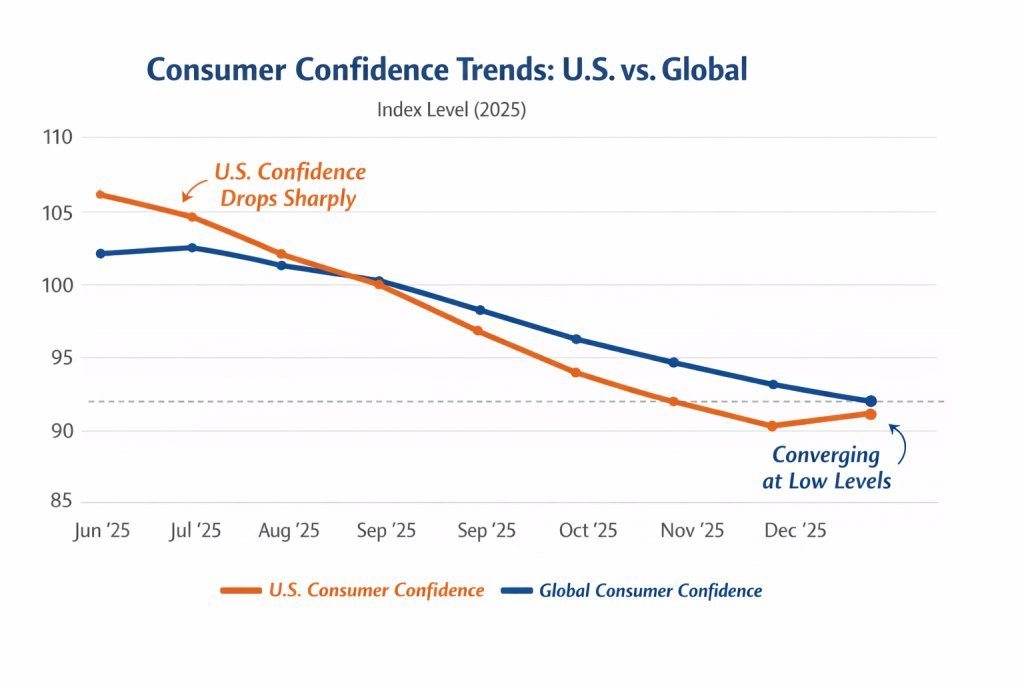
In December 2025, consumer confidence declined for the fifth consecutive month. The drop reflects growing anxiety among households, even as the U.S. economy avoids a technical recession.

Several trends stand out:

  • Fewer consumers believe jobs are plentiful
  • More people say jobs are becoming harder to find
  • Expectations for future income growth remain weak
  • Concerns about prices and affordability persist

This combination suggests that Americans are increasingly worried not just about today, but about what the next few months may bring.


The Job Market: From Strength to Uncertainty

For much of the past two years, a strong labor market helped support consumer spending. Low unemployment and steady hiring gave workers confidence—even as inflation surged.

That confidence is now eroding.

Although unemployment remains relatively low, perceptions matter as much as reality. More Americans now feel that job opportunities are shrinking. Layoff announcements in certain industries, slower hiring, and increased automation have contributed to the belief that the labor market is losing momentum.

When people feel uncertain about job security, they delay major financial decisions. This hesitation ripples through the economy, affecting housing, retail, and service industries.


Inflation Fatigue and the Cost of Living

While inflation has cooled compared to its peak, the psychological impact of high prices lingers.

Consumers are still grappling with:

  • Elevated grocery and energy costs
  • High rent and housing prices
  • Expensive healthcare and education
  • Rising insurance and utility bills

Even when inflation slows, prices rarely return to previous levels. As a result, many households feel that their purchasing power has permanently declined. Wage growth has not fully compensated for years of higher costs, leaving consumers feeling financially squeezed.

This “inflation fatigue” plays a major role in declining confidence.


The Role of Interest Rates and Debt

High interest rates are another critical factor weighing on sentiment. Borrowing has become more expensive across the board:

  • Mortgage rates remain elevated
  • Auto loans cost significantly more than a few years ago
  • Credit card interest rates are at historic highs

For consumers carrying debt, higher rates mean higher monthly payments. For those considering big purchases, financing costs act as a strong deterrent.

As a result, many households are prioritizing debt repayment and savings over discretionary spending—another sign of caution.


Why Confidence Is Falling Despite Economic Growth

One of the biggest puzzles of 2025 is the gap between economic data and lived experience.

Economic IndicatorsConsumer Reality
GDP growth positiveLiving costs feel high
Inflation slowingPrices still elevated
Corporate profits strongHousehold finances stretched

This gap explains why consumer confidence continues to fall even when the economy avoids worst-case scenarios. People base confidence on lived reality, not just statistics.


Why Consumer Confidence Matters So Much

Consumer spending accounts for roughly two-thirds of U.S. economic activity. When confidence weakens:

  • Retail sales may slow
  • Housing demand can weaken
  • Business investment may decline
  • Economic growth becomes more fragile

Confidence often acts as an early warning system. Prolonged declines can signal future slowdowns before they appear in employment or GDP data.


Implications for 2026

The December drop raises important questions about the year ahead.

For Policymakers

A sustained decline in confidence may increase pressure on policymakers to address affordability, job stability, and interest rates. Public sentiment often influences fiscal and monetary decisions, especially in politically sensitive periods.

For Businesses

Companies may need to prepare for more cautious consumers by:

  • Offering value-focused pricing
  • Avoiding aggressive expansion
  • Strengthening customer loyalty

For Households

Consumers are likely to continue prioritizing:

  • Savings and emergency funds
  • Essential spending over discretionary purchases
  • Financial stability over risk-taking

Final Thoughts

The decline in U.S. consumer confidence in December 2025 is not just a number—it’s a reflection of how Americans feel about their economic future. Concerns about jobs, inflation, debt, and affordability have combined to create a climate of caution.

While the economy has not collapsed, confidence has weakened, reminding us that economic health is as much about perception as performance. As the U.S. moves into 2026, restoring consumer confidence may prove just as important as sustaining growth itself.
Uncategorized

Here is the latest news and the official guidelines for the holiday.

It is currently December 25, 2025, and Christmas Day celebrations are in full swing across the United States. This year is particularly notable as the date 12/25/25 is a once-in-a-century mathematical “match.”


🎄 Christmas Day 2025: Top News Stories

1. Record-Breaking Warmth

This is forecast to be the warmest Christmas on record for the contiguous United States. Average highs are hitting $54^{\circ}F$ ($12^{\circ}C$), shattering the previous 2005 record. While the Northeast is seeing some snow, states from California to Indiana are experiencing “T-shirt weather” with temperatures 15–35 degrees above average.

2. The “Federal Bridge” Holiday

In a major move, President Trump issued an executive order declaring both December 24 and December 26 as federal holidays for 2025. This has given federal employees a rare 4-day weekend, though most private-sector businesses remain open today or tomorrow.

3. Travel Chaos: Storms & Flooding

While much of the country is warm, travel has been difficult:

  • West Coast: Heavy storms and “atmospheric rivers” have triggered flood watches for 41 million people in California, Nevada, and Arizona.
  • Northeast: Fast-moving “clipper” storms are bringing snow and freezing rain to New England, causing significant flight delays at JFK, Logan, and Newark.

4. “Warrior Dividend” and Incentives

The administration recently announced a $1,776 “Warrior Dividend” payout for every US soldier as a Christmas thank-you. Additionally, a controversial “mega incentive” of $2.7$ Lakh (approx. $3,000$) was announced for undocumented migrants who choose to leave the US voluntarily this week.


🛡️ Official Celebration Guidelines & Safety

If you are hosting or traveling today, authorities (CPSC, Red Cross, and TSA) have issued these specific guidelines:

Home & Fire Safety

  • The 3-Foot Rule: Keep your Christmas tree and any flammable decorations at least 3 feet away from fireplaces, space heaters, and candles.
  • Hydrate Your Tree: If you have a live tree, it is now at its driest. Add water daily. Dry trees can engulfed a room in flames in less than 30 seconds.
  • Power Strips: Never plug more than three strings of incandescent lights into each other; use a power strip with a surge protector instead.

Health & Kitchen Safety

  • “Turn Handles In”: When cooking large holiday meals, turn pot handles toward the back of the stove to prevent children from pulling hot liquids onto themselves.
  • Cardiac Awareness: Doctors warn of “Holiday Heart Syndrome.” Cold weather, high-sodium meals, and alcohol can spike heart attack risks. If you feel chest pressure or shortness of breath, call 911 immediately.
  • Pet Alerts: Keep chocolate, lilies, mistletoe, and cooked bones away from pets, as these are common causes of emergency vet visits on Christmas Day.

Travel Advice

  • Monitor Apps: With 44 million people traveling, use airline apps to track delays caused by the California floods or New England snow.
  • Emergency Kit: If driving in the Northeast or Midwest, ensure your car has a blanket, flashlight, and salt/sand for icy patches.
#Lifestyle

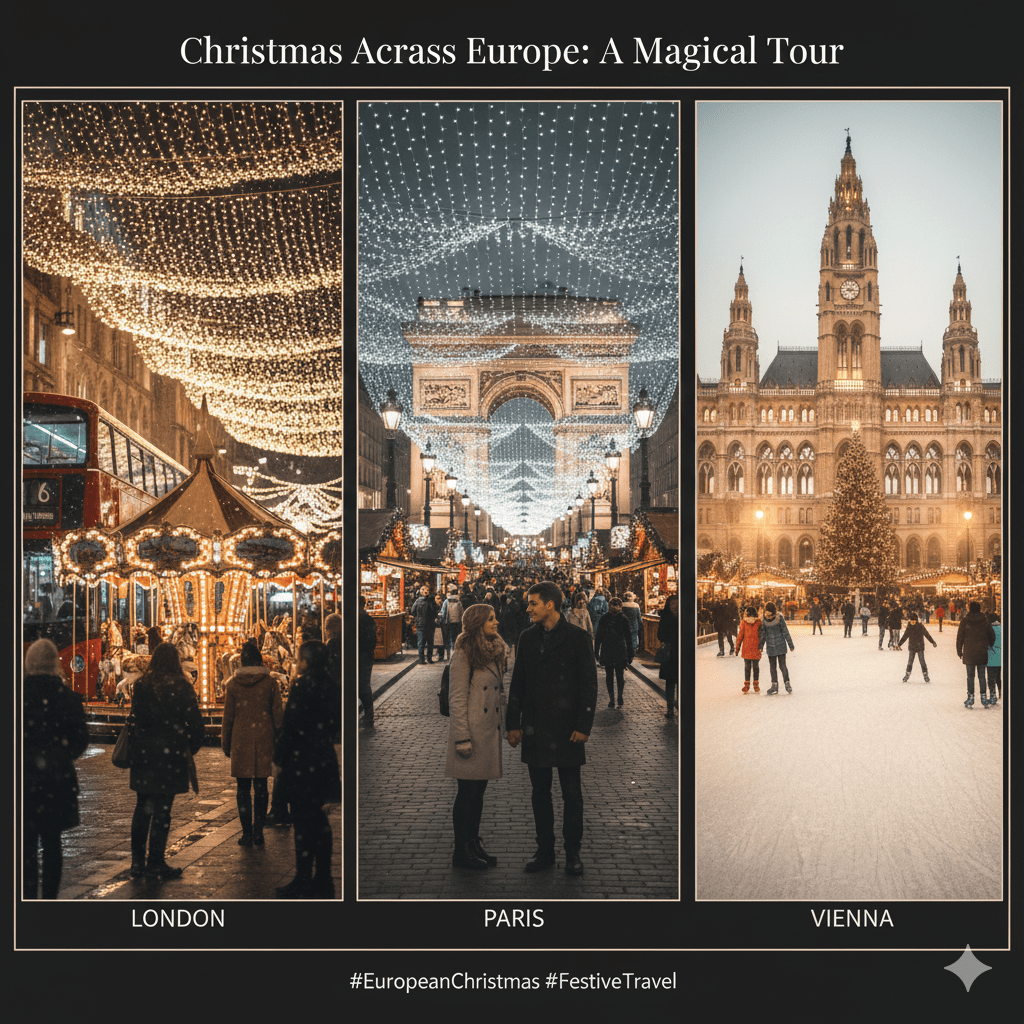
Christmas Across Europe: A Magical Tour Through the Continent’s Festive Capitals

As December descends, Europe transforms into a winter wonderland, each city glowing with its unique festive charm. While the spirit of Christmas unites the continent, the traditions, markets, and culinary delights vary dramatically from one capital to another.

Join us on a virtual tour of Christmas celebrations across some of Europe’s most iconic cities!


1. London, United Kingdom: A Quintessential British Christmas

London during Christmas is a spectacle of lights and traditional cheer.

  • Oxford Street & Regent Street Lights: The dazzling light displays on these iconic shopping streets are world-famous, often accompanied by elaborate window displays from department stores like Harrods and Selfridges.
  • Hyde Park Winter Wonderland: This massive annual event features ice skating, thrilling rides, festive markets, and live entertainment, making it a must-visit for families.
  • Carol Singing: The tradition of carol singing is strong, with performances in Trafalgar Square around the giant Christmas tree (a gift from Norway) and in Westminster Abbey.
  • Pantomimes: A unique British tradition, these comedic musical plays are a beloved holiday pastime for all ages.

2. Paris, France: Noël à la Ville Lumière

Paris, the City of Lights, becomes even more enchanting during the festive season.

  • Champs-Élysées Lights: The grand avenue is illuminated with spectacular displays, leading up to the Arc de Triomphe, creating an unforgettable evening stroll.
  • Marchés de Noël: Traditional Christmas markets pop up across the city, most notably in La Défense, offering artisanal crafts, gourmet treats like vin chaud (mulled wine) and châtaignes grillées (roasted chestnuts).
  • Galeries Lafayette Dome: The iconic department store’s stunning Art Nouveau dome houses an elaborate, often whimsical, Christmas tree that draws crowds.
  • Ice Skating: Temporary ice rinks emerge in picturesque locations, like the one often found outside the Hôtel de Ville.

3. Berlin, Germany: A Historic & Heartfelt Weihnachten

Germany is the birthplace of many Christmas traditions, and Berlin embraces them with gusto.

  • Numerous Christmas Markets: Berlin boasts over 100 Christmas markets, each with its own character. The market at Gendarmenmarkt is particularly beautiful, known for its crafts and gourmet food, while Charlottenburg Palace offers a majestic backdrop.
  • Glühwein & Bratwurst: These staples are found at every market, providing warmth and flavor against the winter chill.
  • Festive Events: From classical concerts to special holiday services in the Berlin Cathedral, the city offers a rich cultural experience.
  • Brandenburg Gate: While not decorated in the traditional sense, the Gate often serves as a focal point for festive gatherings and New Year’s Eve celebrations.

4. Vienna, Austria: An Imperial Christmas Fairytale

Vienna’s imperial architecture provides a breathtaking setting for its Christmas celebrations.

  • Christkindlmarkt at Rathausplatz: The most famous market, set in front of Vienna’s City Hall, is a fairytale of twinkling lights, traditional crafts, and delicious treats like Lebkuchen (gingerbread).
  • Schönbrunn Palace Market: The baroque splendor of Schönbrunn Palace hosts a charming cultural market, perfect for unique gifts.
  • Classical Concerts: Vienna, the city of music, offers an abundance of classical Christmas concerts in historic venues.
  • Ice Dream: After Christmas, the area around Rathausplatz transforms into a huge ice-skating rink, Wiener Eistraum, adding another layer of winter magic.

5. Rome, Italy: Natale in the Eternal City

Christmas in Rome combines ancient history with heartfelt religious traditions.

  • St. Peter’s Square: The Vatican is the spiritual heart of Catholic Christmas, featuring a massive Christmas tree and a life-sized Nativity scene (presepe). Midnight Mass in St. Peter’s Basilica is a profound experience.
  • Piazza Navona Market: Traditionally, this piazza hosts a lively Christmas market with toys, sweets, and carousel rides.
  • Via del Corso Lights: Rome’s main shopping street is adorned with elegant lights, creating a festive atmosphere for shoppers.
  • Presepi Everywhere: Nativity scenes are central to Italian Christmas, displayed in churches, homes, and public spaces throughout the city.

**Which European city’s Christmas celebration sounds most appealing to you?**

Uncategorized

Here is a quick guide to what is open and closed today across the USA.

Since today is Christmas Day (December 25, 2025), most major retailers and grocery stores are closed to allow employees to spend time with their families. However, if you need last-minute medicine, snacks, or a hot meal, there are still several options available.

Here is a quick guide to what is open and closed today across the USA.

🏪 Retailers & Pharmacy Stores (Open Today)

While giants like Walmart, Target, and Costco are closed today, these convenience and drug stores are typically open:

  • Walgreens: Most stores are open (many from 9:00 AM to 5:00 PM), though pharmacy hours vary by location. All 24-hour locations remain open 24/7.
  • CVS Pharmacy: Most locations are open today, but many are operating with reduced holiday hours. Check the CVS app before heading out.
  • 7-Eleven: Most locations remain open 24/7, including today. This is your best bet for emergency milk, eggs, or snacks.
  • Circle K / Safeway / Albertsons: Many of these locations are open today with modified hours.

🍔 Restaurants & Fast Food (Open Today)

Most standalone fast-food restaurants are independently owned, so hours vary by neighborhood. Pro-tip: Use the brand’s mobile app to see if your local branch is active.

  • McDonald’s: Many locations are open today, particularly those in travel hubs or city centers. Expect drive-thru only at some spots.
  • Starbucks: Many stores are open with limited morning/afternoon hours (e.g., closing by 2:00 PM or 4:00 PM).
  • Dunkin’: Most locations are open today, but hours are determined by the individual franchise.
  • Waffle House / Denny’s / IHOP: These “sit-down” favorites are famous for staying open 24/7, 365 days a year, including today.
  • Red Lobster: Open today (typically 11:00 AM to 8:00 PM) at many locations for those wanting a non-traditional holiday dinner.

🚫 Major Stores Closed Today

The following will be fully closed on December 25 and will reopen on December 26:

  • Walmart (Reopens Dec 26 at 6:00 AM)
  • Target (Reopens Dec 26 at 7:00 AM)
  • Costco
  • Aldi / Trader Joe’s / Whole Foods
  • Home Depot / Lowe’s
  • Macy’s / JCPenney

💡 Quick Tip for You

Since it is an unseasonably warm Christmas in much of the country, many people are heading to parks. If you’re doing the same, remember that public restrooms in government-run parks may be closed today due to the federal holiday.